A plain-language guide to Texas ECI for families of children under 3: who qualifies, how to refer, what it costs, what happens at age 3, and when private therapy helps.
Have a question about your child? Our team will listen, answer your questions, and help you find the right next step, with no pressure.
The short answer: Early Childhood Intervention (ECI) is Texas's statewide program for children from birth to 36 months who have a developmental delay, a disability, or a medical diagnosis that can affect development. Any parent can refer their own child. The evaluation is free, and ongoing services are billed on a sliding scale based on family size and income. No family is turned away because they can't pay. ECI ends at your child's third birthday, when support can move to your school district. Many families also start private speech, occupational or ABA therapy alongside ECI, because the two do different jobs.
If you're reading this because something about your toddler's development has you wondering, you're in the right place. Noticing is the first step, and you don't need a diagnosis, a doctor's referral, or certainty to ask for help in Texas.
ECI is run by Texas Health and Human Services (HHS) through local ECI programs across the state. It's part of the federal Individuals with Disabilities Education Act (IDEA), which requires every state to offer early intervention for infants and toddlers. In Texas, that program is ECI.
ECI providers work with your child and family where you already spend your days: at home, at child care, or out in the community. A big part of ECI is coaching parents and caregivers on how to build your child's skills into everyday routines like meals, bath time and play.
Your child can qualify if they are under 36 months old, live in Texas, and meet one of these criteria:
ECI doesn't diagnose autism. If you're wondering about autism, ECI can still evaluate your child's development, and a diagnosis would come separately from a physician or psychologist.
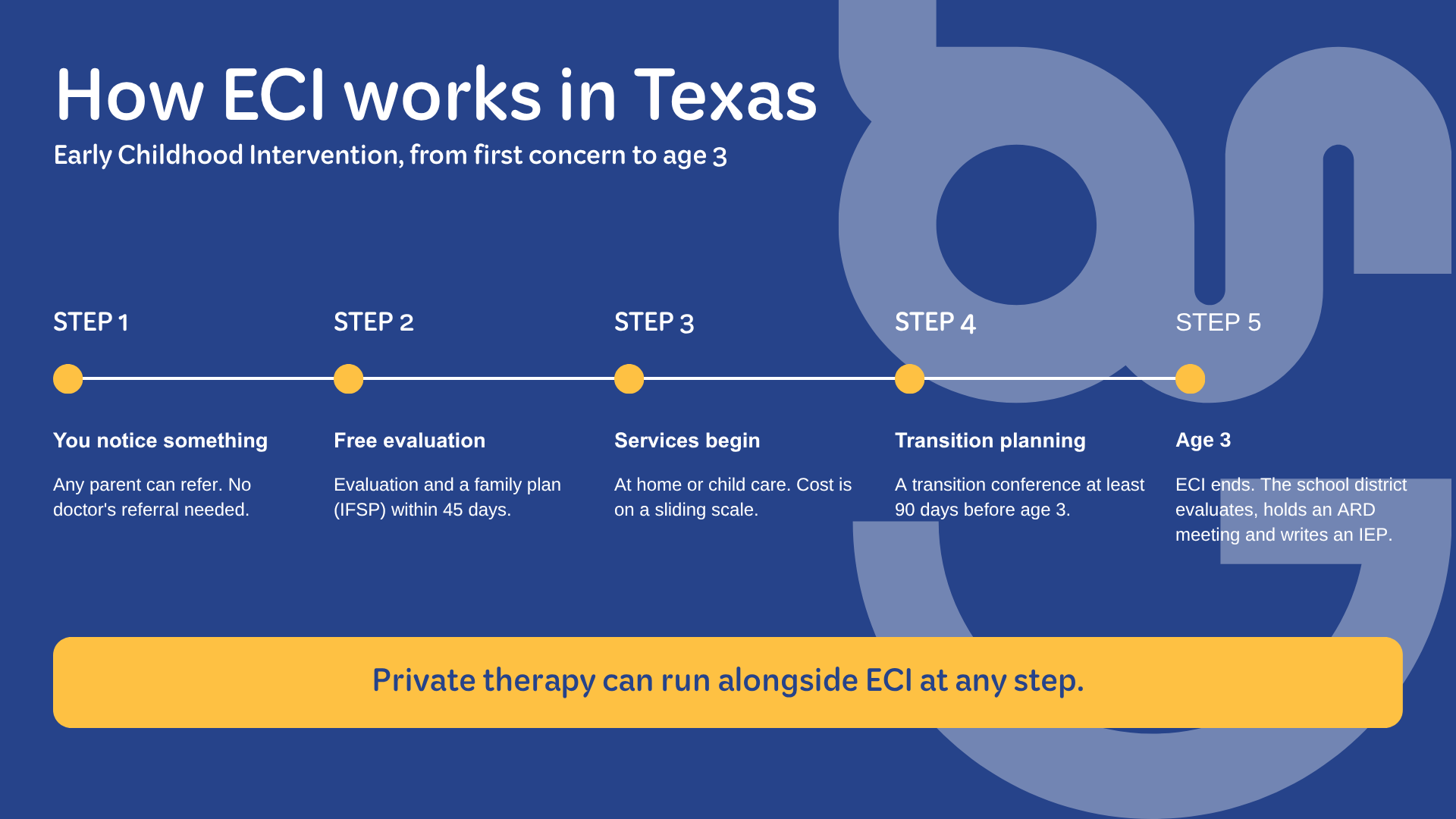
You can refer your own child. You don't need a pediatrician's referral, although doctors, child care providers and others can refer too.
Under federal law, the evaluation, assessment and first planning meeting for an eligible child must happen within 45 days of the referral. That planning meeting produces an Individualized Family Service Plan (IFSP), which sets your goals and services.
These parts of ECI are free to every family: the evaluation and assessment, case management, developing your IFSP, and translation or interpreter services.
For ongoing services, Texas uses a Family Cost Share: a sliding-fee scale based on your family size and income, after allowable deductions. You can also authorize ECI to bill your child's private insurance or Medicaid. Texas HHS is clear on one point: no child or family will be turned away because of an inability to pay.
ECI and private therapy aren't competitors. They're built for different jobs, and families can use both at the same time.
Families often add private therapy when they want more hours than ECI provides, when their child needs a specific kind of support like ABA, or when they want one team that can stay with their child past age 3. Starting private therapy doesn't mean leaving ECI. Many families keep both and ask the two teams to share notes.
ECI ends on your child's third birthday. Before then, ECI helps you plan the next step:
School services focus on what your child needs to learn and take part at school. Many families keep private therapy going alongside ECSE for support outside the school day. Our half-day school-readiness program is built for that in-between stage, when a child is heading toward a classroom but still needs one-on-one support.
If you're in north Texas or the Houston area and want to explore private therapy alongside ECI, these are our Texas centers:
In Texas we accept Aetna, BCBS of Texas, TRICARE, UnitedHealthcare and United Behavioral Health, and we check your benefits before your child's first visit. Learn more about how insurance covers ABA.
You can refer your own child. Use the HHS ECI program search or call 877-787-8999 and select option 3.
Yes. They serve different purposes, and many Texas families use both. Ask both teams to share goals so your child gets one consistent message.
ECI focuses on developmental support and parent coaching in everyday settings. ABA therapy is usually provided by private providers and, in Texas, insurance typically requires an autism diagnosis to cover it.
You can still refer. If your child turns 3 soon, ask about the school district's Early Childhood Special Education evaluation, and consider starting private therapy so support doesn't pause during the handoff.
Sources: Texas Health and Human Services, Early Childhood Intervention Services and Family Cost Share; Texas Education Agency, guidance on the ECI-to-school transition; IDEA Part C regulations.
You don't have to choose between ECI and private therapy. If you'd like more support, a team that stays with your child past age 3, or ABA, speech or occupational therapy, we're glad to talk it through.
One call is enough to start. Call 817-984-8655 and we'll check your benefits and help you find the closest center.



Gracent Pediatric Therapy — formerly Pine Cone Therapies in Texas and includes three North Shore Pediatric Therapy centers in Illinois — is part of the Gracent network and a sister company to North Shore Pediatric Therapy. Together, we’re creating connected, compassionate care for children and families across every stage of growth.
Services at North Shore Pediatric Therapy and Gracent Pediatric Therapy centers are provided by affiliated professional corporations.